Contact

Address
No. 27M/3A, Nguyễn Du Street, Bình Hoà Ward,
Thuận An City, Bình Dương, Vietnam
Email
info@nhatminhfootwear.com
Hotline
+84 329 859 585
Social
Design by MONA.Media
Enquire

Capabilities

One roof in Bình Dương: design, cutting, stitching, lasting, finishing and inspection.

01 / Facility

One site,
every stage on it.

Built as a single operation, not assembled from rented capacity. No stage leaves the site, so a schedule has one owner and a defect has one address.

15,000 Total factory area
500+ Employees
1,000+ Machines
150,000/mo Pairs a month, four lines

Where output goes today, working to twenty per cent annual export growth. Volumes per market and per line are set per programme and are not published.

A wide view down the assembly floor at Binh Duong, with workers at benches along both sides of the line.

Everything you are about to read happens in this room.

15,000 m² in Bình Dương. Five stages, no subcontractor, one address for a defect.

02 / The line

Five stages,
one continuous operation.

A pair crosses the floor once. A fault found at finishing traces to the bench it came from, and a schedule has no handover in it to slip.

01

Design & sampling

We develop and test each style before bulk production. From tech pack to first sample, our team checks fit, construction, materials and production feasibility early to avoid issues later. We can also develop new styles from a customer brief or concept
  • InputTech pack, or a brief and a price point
  • Decided hereLast, sole unit, pattern, materials
  • OutputA sample pair for approval
Coloured shoe lasts and sole units laid out on a sampling bench.
02

Cutting

Uppers, linings and reinforcements are cut to the approved pattern across all sizes. For leather styles, our team carefully selects and positions each part to improve material yield, quality and cost efficiency. Any pattern or material issue is identified early, before bulk production.
  • MaterialsLeather, textile, synthetic, lining, reinforcement
  • Set hereYield, grain placement, size-run accuracy
  • CheckedPanel count and grading against the pattern
Workers at a cutting table sorting stacks of cut leather panels into trays.
03

Stitching

Upper components are skived, folded, stitched and reinforced before assembly. Dedicated machines and skilled operators help keep seams clean, consistent and accurate throughout production. For multi-panel styles, we pay close attention to alignment, especially where different materials or colors meet.
  • EquipmentPost-bed, flat-bed and single-purpose closing machines
  • Drives costPanel count and seam length per pair
  • CheckedSeam placement, stitch density, symmetry
A machinist guiding a leather upper under the needle of a post-bed sewing machine.
04

Lasting & assembly

The stitched upper is shaped over the last and assembled with the sole to achieve the correct fit and final form. Each construction is confirmed during sampling, and lasting and sole assembly are completed in-house for consistent quality and control.
  • FixesFit, shape, sole alignment
  • Varies byLine, construction and last
  • CheckedLasting tension, sole bond, pair matching
A worker operating a lasting machine that presses a leather boot onto its last.
05

Finishing & inspection

Cleaning, dressing, lacing, sock fitting and packing. On a heeled or a leather shoe the finishing room is not a tidy-up at the end, it is a large part of what the customer is actually paying for.

Every pair is then checked against the sample you approved at stage 01 before it is boxed. That approved pair is the reference: not a written specification, not a photograph, but the physical shoe both sides signed off.

  • ReferenceThe approved sample pair
  • ThenBoxed for export on FOB terms
  • Leaves asA finished pair, inspected against sign-off

A worker in an apron finishing a dark leather boot by hand at a bench.
03 / Machinery

Five hundred machines that do one job each.

A general machine can make most things badly. A single-purpose machine, set once and left, makes one thing the same way ten thousand times, which is the whole argument for owning them rather than hiring capacity by the season.

Why it matters to a quote The equipment list is the constraint list

What a factory can quote is decided by what stands on its floor. When you send a construction we do not have the machine for, the honest answer is no rather than a price we cannot hold. When we do have it, the setup is already there rather than bought in against your order.

  • 500+Single-purpose
  • 1,000+Machines in total

What each machine group decides for your order. Counts per group are not published.

  • Workers at a long bench sorting cut tan leather panels beside stacked hides.
    Cutting

    Efficient material use and proper grain placement

  • A machinist at a flat-bed sewing machine with a stack of cut panels beside her.
    Stiching

    How many panels a design can carry.

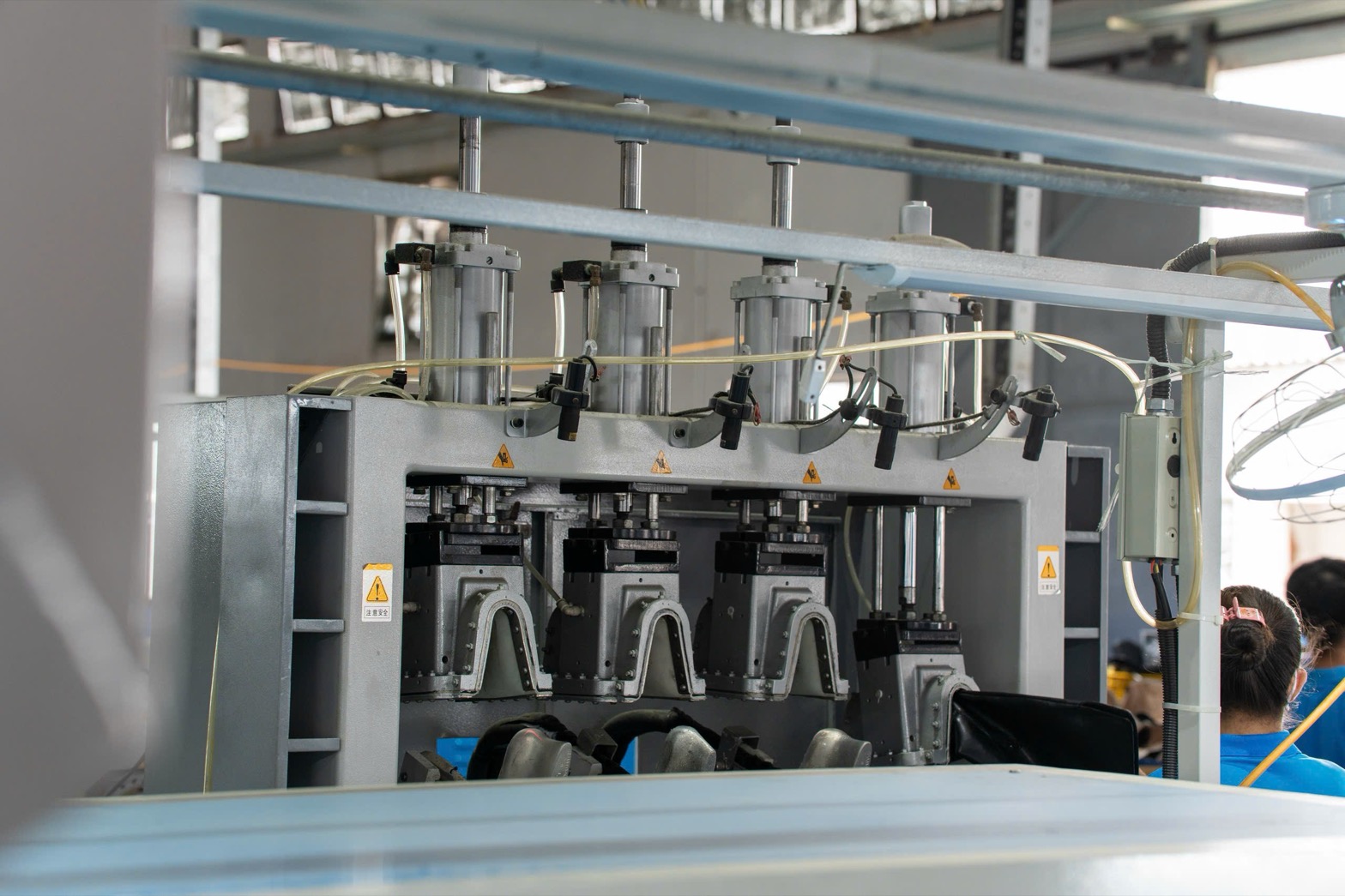
  • A bank of four pneumatic presses fitted with shoe-shaped moulds.
    Lasting & assembly

    Which constructions we can build.

  • A worker in an apron dressing the shaft of a dark brown leather boot by hand.
    Finishing

    The surface a customer judges first.

  • Steel racking holding trays of blue lasts, with a worker lifting one down.
    Support

    How fast work moves between stages.

04 / Control

The questions
buyers actually ask.

Answered plainly, including the two where the answer is that we will send you the document rather than summarise it here.

Who is responsible if something goes wrong mid-production?

We are, at every stage, because there is no other party involved. Cutting, closing, lasting and finishing are all ours, so a defect has a bench, a shift and a machine attached to it rather than a supplier to chase.

A single-purpose press standing on the factory floor between production lines.
The floor the answer is about
Do you publish an AQL and a sampling plan?

Not on this page. Inspection levels are agreed per programme and set out in the order documentation — a buyer with their own quality manual will normally want theirs applied. Ask and we will send what we work to.

Who verifies any of this apart from you?

One certification and three audit programmes: certified to the Global Recycled Standard, audited under amfori BSCI, SMETA 4-Pillar and SCAN. Between them they cover recycled content and its chain of custody, labour practice, health and safety, environment, business ethics and supply chain security.

GRS is a certification and issues a certificate. amfori BSCI, SMETA 4-Pillar and SCAN are audit programmes: they produce audit reports, not certificates. What each one covers.

Certificate numbers, issuing bodies and validity dates are sent on request rather than published.

Who buys the materials?

Nhật Minh works on FOB terms: we source leather, linings, sole units and components ourselves, so a late material becomes our problem rather than your delay. We can also build to suppliers you have already approved — the floor works the same way either way, and only the material risk changes. How the terms work.

Who owns the pattern and the last?

On an OEM order, you do: you supplied the specification and it stays yours. On an ODM development, what happens to the model afterwards is agreed in writing before development starts rather than assumed. The three routes.

05 / Orders

Production planning & lead time.

At Nhat Minh Footwear, we combine flexible production planning with a structured development process to support reliable delivery and consistent quality.

MOQ 2,000 pairs / style
  • Minimum order quantity: 2,000 pairs per style.
  • Orders can be distributed across up to 3 colors.
Development & Lead Time 60–80 days
  • Standard timeline: approximately 60–80 days from order confirmation, including material sourcing and preparation.
  • If materials are already specified and approved, the timeline can be reduced to approximately 45 days.
  • The first month is typically focused on sample development, fitting, testing, and customer approval before bulk production begins.
Bulk Production 3–4 weeks
  • Standard production cycle: approximately 3–4 weeks, depending on product construction, materials, and order complexity.
  • Our production team works closely with customers from development through bulk production to improve efficiency, manage timelines, and ensure orders are ready for shipment as scheduled.
A long aisle running between two assembly lines, benches on both sides.
The length of one line
06 / Visit

Come and walk it.

The shortest route to trusting a factory is standing in it. We host buyers at the plant in person, or walk the line on a video call if the trip is not practical yet.